
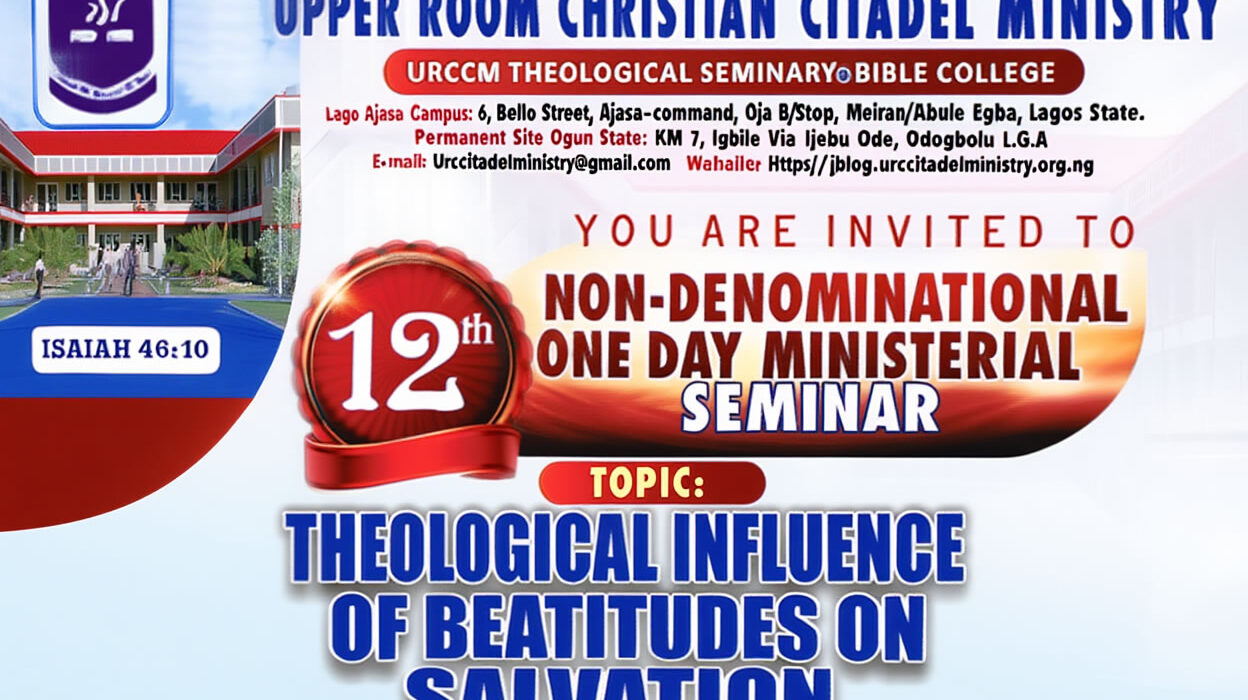

UPPER ROOM CHRISTIAN CITADEL MINISTRY
(URCCM THEOLOGICAL SEMINARY/BIBLE COLLEGE)
AJASA – BELLO CAMPUS
6, Bello Street, Ajasa Command, Postcode 100278, Ipaja.
Permanent Site: Kilometer 7, Igbile/Jobore, Via Ijebu – Ode, Odogbolu LG. Ogun State. Nigeria.
E-mail: urccitadelministry@gmail.com | Web: urccitadelministry.org.ng
https://jblog.urccitadelministry.org.ng | 08033573960, 08091567481, 08125763709.
URCCM 12th Non-Denomination One Day Ministerial Seminar
Date: May 14, 2026
Topic: Theological Influence of Beatitudes on Salvation. (Matthew 5:1-12)
1.0 INTRODUCTION
I don’t know about you, but I am troubled lately with some profound questions on our Christian ethics.
Most pressing to me is the question about our individual and collective mission as Christians heading towards securing citizenship of God’s kingdom. In other words, how are we to live and behave in our very complex world. The world our God so loved (John 3:16) but Our Lord Jesus Christ prayed not for the world because “I have given them thy word; and the world hath hated them…” John 17:9,14.
Becoming difficult each day to see the behavioral influence of average Christian in the society, including the home, even though when we are together in the Assembly of “called out” our pretenses will always be taken as Christian indeed! Whao!
Although the primary purpose of the beatitudes is to declare the blessings given by God’s kingdom, most scholars also regard them as painting a picture of the character of that kingdom. Beatitude means supreme blessedness, exalted happiness, a state of profound joy and contentment.
As we step into God’s kingdom, we hope to become more like those named as blessed—more meek, more merciful, hungrier for righteousness, more apt to make peace, and so on.
This gives the beatitudes a moral imperative. Later, when Jesus says, “Make disciples of all nations” (Matt. 28:19), the beatitudes describe the character these disciples are meant to take on.
Citizenship in God’s kingdom begins now. The character of the kingdom community is perfected when Jesus returns, “coming on the clouds of heaven with power and great glory” (Matt. 24:30).
With this understanding, we are ready to explore the specific character of each of the beatitudes and explore how it applies to work. We cannot attempt to discuss each beatitude exhaustively, but we hope we can lay the groundwork for receiving the blessings and living out the beatitudes in our daily work.
However, lets view the scenario where this important sermon was delivered. Immediately after the temptation, Matthew 4:23, “And Jesus went about Galilee, teaching in their synagogues and preaching the gospel of the kingdom, and healing all manner of sickness, and all manner of disease among the people.”
In this longest recorded sermon, Jesus began by describing the traits he was looking for in his followers. He called those who lived out those traits fortunate because God had something special in store for them. Each beatitude is an almost direct contradiction of society’s typical way of life. In the last beatitude, Jesus even points out that a serious effort to develop these traits is bound to create opposition. The best example of each trait is found in Jesus himself. If our goal is to become like him, the beatitudes will challenge the way we live each day.
The Sermon on the Mount was so called, because Jesus gave it on a hillside near Capernaum. This sermon probably covered several days of preaching. In it, Jesus proclaimed his attitude toward the Law. Position, authority, and money are not important in his Kingdom—what matters is faithful obedience from the heart.
The Sermon on the Mount challenged the proud and legalistic religious leaders of the day. It called them back to the messages of the Old Testament prophets who, like Jesus, taught that heartfelt obedience is more important than legalistic observance.
There are at least four ways to understand the beatitudes:
(1) They are a code of ethics for the disciples and a standard of conduct for all believers.
(2) They contrast Kingdom values (what is eternal) with worldly values (what is temporary).
(3) They contrast the superficial “faith” of the Pharisees with the real faith Christ wants.
(4) They show how the Old Testament expectations will be fulfilled in the new Kingdom.
These beatitudes are not multiple choice—pick what you like and leave the rest. They must be taken as a whole. They describe what we should be like as Christ’s followers. (Just as we take ‘the whole Armor of God’ – Ephesians 6:10-17 and ‘the fruit of the spirit’ – Galatians 5:22-23).
With Jesus’ announcement that the Kingdom was at hand (4:17), people were naturally asking, “How do I qualify to be in God’s Kingdom?” Jesus said that God’s Kingdom is organized differently from worldly kingdoms. In the Kingdom of heaven, wealth and money, power and authority are unimportant. In heaven the medium of exchange is not money but faith. Kingdom people seek different blessings and benefits, and they have different attitudes. Are your attitudes a carbon copy of the world’s selfishness, pride, and lust for power, or do they reflect the humility and self-sacrifice of Jesus, your King?
When Jesus began this sermon with words that seem to contradict each other. But God’s way of living usually contradicts the world’s way. If you want to live for God, you must be ready to say and do what seems strange to the world. You must be willing to give when others take, to love when others hate, to help when others abuse. By giving up your own rights in order to serve others, you will one day receive everything God has in store for you.
Furthermore, the Beatitudes can best be described as a Salvation-Focused Sermon as delivered by our Lord and Saviour, Jesus Christ (Matthew 5:3-12). They serve as a roadmap to salvation, outlining the inner attitudes of heart receptiveness to God’s grace and the Kingdom of Heaven.
Rather than rules for works-based salvation, they describe a spiritual transformation—humility, repentance, and righteousness—that recognizes the need for Christ, ultimately leading to blessing, comfort, and eternal reward.
“…work out your salvation with fear and trembling. For it is God which works in you both to will and to do of his good pleasure.” Philippians 2:12-13.
These striking eight statements made some 2000 years ago are the blueprint for our mission as Christians. They were radical then and they are still very radical now.
The Beatitudes do not promise an easy life, but they do promise a life of deep meaning, purpose, and eternal reward.
They guide us to live not for the fleeting approval of the world, but for the lasting joy found in God. When we follow this path, we are truly blessed, may be not in the eyes of the world, but much more importantly, in the eyes of God.
As we ponder our Christian mission, let us take to heart these eight beatitudes which Jesus laid out as the path to salvation. In a world driven by competition, pride, and material success, the Beatitudes challenge us to embrace a life rooted in humility, and a relentless pursuit of righteousness.
The Beatitudes offer a powerful antidote to the tempting, yet false paths offered by our world. The beatitudes offer us much needed hope for our world.
Thus, the beatitudes are first of all declarations of God’s grace. The beatitudes further describe the character of God’s kingdom, but they are not conditions of salvation. Jesus does not say, for example, “Only the pure in heart may enter the kingdom of heaven.” This is good news because the beatitudes are impossibly hard to fulfill.
The beatitudes are not a judgment against all who fail to measure up. Instead, they are a blessing for any who consent to join themselves to God’s kingdom as it “comes near.”
2.0 THE BEATITUDES
2.1 The Gift of Grace (Poor in Spirit – Humility)
The first Beatitude, “Blessed are the poor in spirit: for theirs is the kingdom of heaven.” Matthew 5:3
By poverty in spirit, Jesus does not mean lacking in intelligence, faith or joy. Instead, to be poor in spirit is to know that our true strength is not relative to our accomplishment and our true worth does not come from our possessions, rather these are rooted in our relationship with God, the source of all that is.
The “poor in spirit” are those who cast themselves on God’s grace. We personally acknowledge our spiritual bankruptcy before God. It is the tax collector in the temple, beating his breast and saying, “God, be merciful to me, a sinner” (Luke 18:9-14). It is an honest confession that we are sinful and utterly without moral virtues needed to please God. It is the opposite of arrogance. In its deepest form, it acknowledges our desperate need for God. Jesus is declaring that it is a blessing to recognize our need to be filled by God’s grace.
Thus, at the very beginning of the Sermon on the Mount, we learn that we don’t have the spiritual resources in ourselves to put Jesus’ teachings into practice. We can’t fulfill God’s call by ourselves. Blessed are those who realize they are spiritually bankrupt, for this realization turns them to God, without whom they cannot fulfill what they are created to do and be. Much of the rest of the sermon rips away from us the self-delusion that we are capable of acquiring a state of blessedness on our own. It aims to produce in us a genuine poverty of spirit.
What is the practical result of this blessing? If we are poor in spirit, we are able to bring an honest appraisal of ourselves to our work. We don’t inflate our résumé or boast about our position. We know how difficult it is to work with people who cannot learn, grow, or accept correction because they are trying to maintain an inflated picture of themselves. So, we commit ourselves to honesty about ourselves. We remember that even Jesus, when he started working with wood (as a son of a carpenter), must have needed guidance and instruction. At the same time, we acknowledge that only with God at work within us can we put Jesus’ teachings into practice on the job. We seek God’s presence and strength in our lives each day as we live as Christians where we work.
To be poor in spirit means you know that all of your self-righteousness is as filthy rags and all of your self-propelled achievements are short-term and fleeting at best (see Isaiah 64:6).
To be poor in spirit means that you know you need God. Why would this cause you to be ‘blessed’? Because you are open to receiving God’s free gift of salvation and allowing the Holy Spirit to work in your life. You are willing to humble yourself and pray: ‘Lord Jesus, I need You. I accept You as my Saviour. I want to yield my life to Your will and do things Your way to the glory of Your Name.’
Summary Profile:
• Beatitude: Matt. 5:3 – Humility
• Old Testament: Isa. 57:15
• Clashing Worldly Values: Pride & personal independence
• God’s Reward: Kingdom of heaven
• How to develop: James 4:7-10
2.2 Repentance (Those Who Mourn – Mourning)
The second Beatitude: ‘Blessed are those who mourn, for they shall be comforted.’ Matthew 5:4 NKJV.
Jesus was not necessarily speaking about mourning the loss of a loved one, but that those who mourn over their sins will receive God’s comfort. When you weep over your sins and the trouble they brought to yourself and to others, you put yourself in a position to receive God’s forgiveness. True repentance does not focus on self. It’s not morbid or despairing; it doesn’t come from false humility or from wallowing in self-pity. It is acknowledging openly, plainly, and simply that you need God’s mercy and grace.
When we face the evil in our own lives, it saddens us; when we face the evil in the world—which includes possible evil in our workplace—that, too, touches our emotions with grief. The evil may come from ourselves, from others, or from sources unknown. In any case, when we honestly mourn evil words, evil deeds, evil policies on the job, God sees our sorrow and comforts us with the knowledge that it will not always be this way. Mourning is more than sadness. It is an expression of true empathy and compassion. As we grieve with others, we participate in God’s healing work, offering comfort and hope amid life’s losses. Our ability to mourn is a sign of deep and gratuitous love.
Those blessed with mourning about their own failings can receive comfort by admitting their errors. If we make a mistake with a colleague, student, customer, employee, or other person, we admit it and ask their pardon. This takes courage! Without the emotional blessing of sadness over our actions, we would probably never muster the guts to admit our mistakes. But if we do, we may be surprised how often people are ready to forgive us.
As long as you delight in your sins, try to justify them, or blame others for them, you cannot be forgiven. It is only when you pray, ‘I confess that I have sinned against You in my thoughts, my words, and my actions’ that you put yourself into a position to be cleansed of your sin.
The Bible says, ‘If we say that we have no sin, we deceive ourselves, and the truth is not in us. If we confess our sins, He is faithful and just to forgive us our sins and to cleanse us from all unrighteousness’ (1 John 1:8-9 NKJV). And in that is your comfort!
It is God’s forgiveness that produces genuine joy and comfort in your souls. It is God’s forgiveness that heals your deep inner wounds, and that restores you to intimacy with your heavenly Father. The blessing of comfort is for those who mourn over their sins and the brokenness of the world, leading to true penitence.
Summary Profile:
• Beatitude: Matt. 5:4 – Mourning
• Old Testament: Isa. 61:1,2
• Clashing Worldly Values: Happiness at any cost
• God’s Reward: Comfort (2 Cor. 1:4)
• How to develop: Ps. 51; James 4:10
2.3 Submission (The Meek – Meekness & Lowliness)
The third Beatitude: ‘Blessed are the meek [gentle], for they shall inherit the earth.’ Matthew 5:5 NKJV
The third beatitude puzzles many people in the workplace, in part because they don’t understand what it means to be meek. Many assume the term means weak, tame, or deficient in courage. But the biblical understanding of meekness is power under control. In the Old Testament, Moses was described as the meekest man on earth (Numbers 12:3, KJV). Yet he was willing to go toe-to-toe with Pharaoh, to lead a grumbling people across a wilderness, and to climb a smoking, shaking mountain to meet personally with almighty God.
Jesus described Himself as ‘gentle and lowly in heart’. Jesus described himself as “meek and lowly” (Matt. 11:28-29, KJV), which was consistent with his vigorous action in cleansing the temple (Matt. 21:12-13).
Power under God’s control means two things: (1) refusal to inflate our own self-estimation; and (2) reticence to assert ourselves for ourselves. Paul captures the first aspect perfectly in Romans 12:3. “For by the grace given to me I say to everyone among you not to think of yourself more highly than you ought to think, but to think with sober judgment, each according to the measure of faith that God has assigned.”
Meek people see themselves as servants of God, not thinking more highly of themselves than they ought to think. To be meek is to accept our strengths and limitations for what they truly are, instead of constantly trying to portray ourselves in the best possible light. But it does not mean that we should deny our strengths and abilities.
When asked if he was the Messiah, Jesus replied, “The blind receive their sight, the lame walk, the lepers are cleansed, the deaf hear, the dead are raised, and the poor have good news brought to them. And blessed is anyone who takes no offense at me” (Matt. 11:4-6). He had neither an inflated self-image nor an inferiority complex, but a servant’s heart based on what Paul would later call “sober judgment” (Romans 12:3).
Meekness is not weakness. Trusting in God, the meek discover deep peace, something the world cannot give. The meek need not assert themselves aggressively. Their strength comes from the quiet confidence in God’s power rather than their own.
What made Moses and Jesus meek? They manifested supreme power under control. Proverbs 16:32 (NKJV) describes this kind of power: ‘He who is slow to anger is better than the mighty, and he who rules his spirit than he who takes a city.’ Proverbs 25:28 (NASB) tells us the flip side of meekness: ‘Like a city that is broken into and without walls so is a person who has no self-control over his spirit.’
The meek are those who have the power to hurt but choose not to. They have knowledge to destroy someone’s reputation, but they don’t use it. They have reason to hate but refuse to act on it. Such people exhibit meekness, which is simply strength harnessed and used to do good. And those who exercise meekness walk in God’s blessing. The meek persevere until good overcomes evil, answers are found, remedies are generated, and reconciliation overcomes estrangement. And the meek sleep well at night – because their trust is in the Lord! Meekness is not weakness but submission to God’s will, trusting in His righteousness rather than our own efforts.
In contrast, Jesus said that the meek “will inherit the earth.” As we have seen, the earth has become the location of the kingdom of heaven. We tend to think of the kingdom of heaven as heaven, a place completely different (golden streets, gates of pearl, a mansion over the hilltop) from anything we know here. But God’s promise of the kingdom is a new heaven and a new earth (Revelation 21:1). Those who submit their power to God will inherit the perfect kingdom coming to earth. In this kingdom, we receive by God’s grace the good things the arrogant fruitlessly strive for in the present earth, and more. And this is not a future reality only. Even in a broken world, those who recognize their true strengths and weaknesses can find peace by living realistically. Those who exercise power for the benefit of others are often admired. The meek engage others in decision making and experience better results and deeper relationships.
Summary Profile:
• Beatitude: Matt. 5:5 – Meekness & Lowliness
• Old Testament: Ps. 37:5-11
• Clashing Worldly Values: Power
• God’s Reward: Wide world belongs to you
• How to develop: Matt. 11:27-30
2.4 Spiritual Hunger (Hunger and Thirst for Righteousness, Justice and goodness)
The fourth Beatitude: ‘Blessed are those who hunger and thirst for righteousness, for they shall be filled.’ Matthew 5:6
Righteousness is not an optional spiritual supplement; it’s a necessity for Christian living. It’s something you must desire as much as a starving man desires food and a thirsty man desires water. Are you hungry for more of Jesus? Do you have an appetite for His Word? Do you long to experience the kingdom of God? If so, Jesus says that you will be ‘filled’. He will give you more of Himself.
Understanding the fourth beatitude turns on understanding what Jesus meant by righteousness. In ancient Judaism, righteousness meant “to acquit, vindicate, restore to a right relationship.” The righteous are those who maintain right relationships—with God and with the people around them. On the basis of right relationships, those who commit infractions are acquitted of guilt.
Have you received the blessing of being filled with right relationships? It flows from meekness (the third beatitude) because we can only form right relationships with others when we cease making all our actions revolve around ourselves. Do you hunger and thirst for right relationships—with God, with your co-workers, with your family, and your community? Hunger is a sign of life. We are genuinely hungry for good relationships if we yearn for others for their own sake, not just as snack food for meeting our own needs. If we see that we have God’s grace for this, we will hunger and thirst for right relationships, not only with God, but with the people with whom we work or live.
Jesus says that those who have this hunger will find their appetites filled. It is easy to see the wrongs in our workplaces and to want to do battle to fix them. If we do this, we are hungering and thirsting for righteousness, desiring to see wrongs righted. The Christian faith has been the source of many of the greatest reforms in the work world, perhaps most notably the abolition of slavery in Great Britain and the United States, and the genesis of the Civil Rights movement. But again, the flow of the beatitudes is important. We don’t take on these battles in our own strength, but only in recognition of our own emptiness, mourning our own unrighteousness, submitting our power to God.
To hunger and thirst for righteousness is to make it our life’s purpose to seek God’s will and to help realize God’s vision and hope for our world. It means to be passionate about truth, goodness and justice.
God keeps His promises, and He will keep this one also: ‘Blessed are those who hunger and thirst for righteousness, for they shall be filled.’
A desire for the righteousness that only God provides, which leads to being satisfied by Him.
Summary Profile:
• Beatitude: Matt. 5:6 – Justice & Righteousness
• Old Testament: Isa. 11:4,5; 42:1-4
• Clashing Worldly Values: Pursuing personal needs
• God’s Reward: Complete satisfaction
• How to develop: John 16:5-11, Phil. 3:7-11
2.5 The Fifth Beatitude (Kindness and Mercy)
‘Blessed are the merciful, for they shall obtain mercy.’ Matthew 5:7
Mercy is more than forgiveness, less than love, different from grace, and one with justice. Forgiveness becomes operational only when a wrong is committed, but mercy is operational at all times. Mercy leads to and produces forgiveness, but mercy is more than forgiveness. Mercy reaches out to the weak, to the needy, and to those needing protection and direction.
Mercy is at the heart of God, and it must be at the heart of every Christian. When we forgive, when we show compassion, when we reach out to those in need, our actions reflect God’s love.
If you are blessed with sorrow for your own failings (the second beatitude) and with right relationships (the fourth beatitude), you will not find it difficult to show mercy to others on the job or anywhere else. Mercy consists of treating people better than they deserve from us. Forgiveness is a type of mercy. So is aiding someone whom we have no obligation to help, or forbearing to exploit someone’s vulnerability. Mercy, in all these senses, is the driving force of Christ’s incarnation, death, and resurrection. Through him, our sins are forgiven and we ourselves receive aid by the gift of God’s spirit (1 Corinthians 12). The Spirit’s reason for showing us this mercy is simply that God loves us (John 3:16).
Just as forgiveness flows out of mercy, so mercy flows out of love. Love is the source of mercy, but love is greater than mercy – it exists apart from any need or sin. Mercy offers a reprieve from punishment, but grace offers complete pardon. Mercy relieves our pain, but grace cures the disease. Mercy overlooks the mistakes, but grace forgets the mistakes. God is both merciful and just at the same time. Mercy that ignores or refuses to deal with sin is a false mercy. Justice requires that we face and deal with sin. Mercy grants us the privilege of facing and dealing with it so we might be forgiven of it.
Jesus said, ‘Blessed are the merciful, for they shall obtain mercy.’ The more mercy we exercise, the more mercy we receive from God. We are to be conduits for God’s mercy with an ever-increasing capacity to impart it to others. The person who exercises mercy is unshackled from emotional chains, freed of spiritual bondage, and liberated from the bitterness that hinders spiritual growth. Mercy flowing from God to us removes the blockages that keep us from becoming whole. And the good news is that we will never be asked to extend more mercy to others than God has extended to us.
Summary Profile:
• Beatitude: Matt. 5:7 – Kindness and Mercy
• Old Testament: Psalm 41:1
• Clashing Worldly Values: Strength without feeling
• God’s Reward: Receive mercy
• How to develop: Eph. 5:1,2
2.6 Internal Transformation (Pure in Heart – Hearts that are pure)
The sixth Beatitude: ‘‘Blessed are the pure in heart, for they shall see God.’’ Matthew 5:8
The sixth beatitude echoes Psalm 24:3-5: “Who may ascend the hill of the Lord? And who shall stand in his holy place? Those who have clean hands and pure hearts, who do not lift up their souls to what is false, and do not swear deceitfully. They will receive blessing from the Lord, and vindication from the God of their salvation.”
“Clean hands and pure hearts” denote integrity, singleness of devotion, undivided loyalty. Integrity goes well beyond avoiding deceit and bad behavior. The root of integrity is wholeness, meaning that our actions are not choices we put on or take off as may seem convenient, but stem from the whole of our being. Notice that Jesus pronounces the blessing of being pure in heart not right after the blessing of hungering for righteousness, but after the blessing of showing mercy. Purity of heart arises not from perfection of our will, but from reception of God’s grace.
It is the cleansing of a person’s destructive attitudes. The biblical word refers to a cleansing of all impurities from your inner spirit – impurities that include evil tendencies, evil thoughts, evil desires, lust of the flesh, lust of the eyes, and pride of life (1 John 2:16).
To be pure is to have all these impurities removed so that you might reflect the character of Christ Jesus.
Purity is not just about avoiding sin. Purity is about having undivided loyalty to God. A pure heart is one that seeks God above all else, unclouded by selfish motives or distractions.
One of the main plagues in our society today, and even in many churches, is double mindedness. We have mixed motives, a divided mind and heart. We must put an end to segregating our lives, which causes us to speak and act one way around fellow Christians and another way around those who don’t know Christ. Jesus said very plainly, ‘No man can serve two masters’ (Matthew 6:24 KJV).
To be pure in heart is to have integrity – to have your heart, your head, and your hands fully integrated and aligned with the commands of God. To be a person of integrity is to say what you believe, and then do what you say.
Salvation transforms the heart, focusing on inner purity and sincerity in relationship with God rather than just external obedience. Peace with men and peace with God.
Summary Profile:
• Beatitude: Matt. 5:8 – Hearts that are pure
• Old Testament: Ps. 24:3,4; 51:10
• Clashing Worldly Values: Deception is acceptable
• God’s Reward: To see God
• How to develop: 1 John 3:1-3
2.7 The Seventh Beatitude (PEACE)
‘‘Blessed are the peacemakers, for they shall be called sons of God.’’ Matthew 5:9
Following Jesus may bring suffering, but it validates our place in the Kingdom of Heaven, connecting our present life to eternal rewards. In a world torn by lies and division, hatred and violence, we are called to be agents of reconciliation and healing. Peacemaking requires deep listening, respectful dialogue, and a willingness to forgive. This is not an easy task, but it is essential to our Christian mission.
The seventh beatitude takes every Christian worker into the task of conflict resolution. Conflicts arise whenever people have differences of opinion. In a fallen world, the tendency is to ignore conflict or suppress it by using force, threat, or intimidation. But both of those are violations of the integrity (the sixth beatitude) of the people in conflict. In God’s kingdom, it is a blessing to bring people together who are in conflict. Only then is it possible to resolve the conflict and restore the relationships. (Later in this article, we will explore Jesus’ method for conflict resolution in Matt. 18:17-19).
The result of conflict resolution is peace, and peacemakers will be called “children of God.” They will reflect the divine character in their actions. God is the God of peace (1 Thessalonians 5:23) and we show ourselves to be his children when we seek to make peace in the workplace, in the community, in our homes, and in the whole world. The Hebrew word for ‘peace’ is ‘shalom’; it refers to a sense of well-being that produces calmness and confidence, even in a crisis.
You must make God’s Word the foundation of all you believe and, therefore, of all you say and do. You must take God at His Word and surrender your will to His commandments and His plan. You must root your expectations and hope in His promises and His desires.
True peace of heart is always built on truth – the truth of who God is, who you are ‘in Him’, and how God wants you to relate to Him and with others.
To know God’s truth is to experience God’s peace. As you seek to bring this kind of peace to the hearts of others, you are acting like your heavenly Father. It is God’s desire that you be reconciled to Him and experience salvation and genuine heart peace. Our message is this: ‘Acquaint yourself with Him, and be at peace; thereby good will come to you’ (Job 22:21 NKJV). Paul put it this way: ‘Having been justified by faith, we have peace with God through our Lord Jesus Christ’ (Romans 5:1 NKJV). Our ultimate role as peacemakers is not simply to see men and women at peace with one another but also at peace with God.
Summary Profile:
• Beatitude: Matt. 5:9 – PEACE
• Old Testament: Isa. 57:18,19; 60:17
• Clashing Worldly Values: Personal peace without concern for world chaos
• God’s Reward: Be called sons of God
• How to develop: Rom. 12:9-21; Heb. 12:10-11
2.8 Kingdom Focus (Persecution, Faithfulness)
The eighth Beatitude: ‘‘Blessed are those who are persecuted for righteousness’ sake.’’ Matthew 5:10
The eighth and final beatitude may strike us as negative. Up to this point, the beatitudes have focused on humility, meekness, right relationships, mercy, purity of heart, and peacemaking—all positive qualities. But Jesus includes the possibility of “persecution for righteousness’ sake.” This arises from the previous seven, because the forces that oppose God’s ways still hold great power in the world.
Note that persecution arising from unrighteous behavior is not blessed. If we fail through our own fault, we should expect to suffer negative consequences. Jesus is talking about the blessing of being persecuted for doing right.
But why would we be persecuted for righteousness? The reality in a fallen world is that if we demonstrate genuine righteousness, many will reject us. Jesus elaborates by pointing out that the prophets, who like him announced God’s kingdom, were persecuted. “Blessed are you when people revile you and persecute you and utter all kinds of evil against you falsely on my account. Rejoice and be glad, for your reward is great in heaven, for in the same way they persecuted the prophets who were before you” (Matt. 5:11-12).
Jesus said: ‘Blessed are those who are persecuted for righteousness’ sake, for theirs is the kingdom of heaven. Blessed are you when they revile and persecute you, and say all kinds of evil against you falsely for My sake. Rejoice…for great is your reward in heaven’ (vv. 10-12 NKJV). To be persecuted for righteousness’ sake is to live as Jesus lived – with His character, His motives, His obedience, His trust in the Father, and His purity of heart. It’s to be a peacemaker, to hunger and thirst for what’s right, to turn your back on sin, and to be a fountain of mercy. If you live this way, you’ll be persecuted just as Jesus was persecuted.
You won’t have to be confrontational in what you say or do – your very life will be confrontational. It’s the contrast that will bring confrontation! Jesus spoke the truth, lived the truth, and was willing to die for the truth. He never sought to pick a fight, but He spoke up every time the truth He spoke was challenged. And He promises that when you are insulted and abused for the same reasons He was, if you remain faithful, you will receive the kingdom of heaven. In other words, you’ll have a reward in heaven, and you’ll be given spiritual authority in the kingdom of heaven. What you may suffer here on earth is only temporary rejection, insult, or abuse. What you gain in heaven will be eternal and glorious. The Bible says: ‘The sufferings of this present time are not worthy to be compared with the glory which shall be revealed in us’ (Romans 8:18 NKJV).
Commitment to God’s truth may bring opposition or suffering, but Jesus reminds us that such trials are not defeats. On the contrary, they are signs that we are on the path to salvation.
Summary Profile:
• Beatitude: Matt. 5:10 – Persecution & Faithfulness
• Old Testament: Isa. 52:13
• Clashing Worldly Values: Weak commitments
• God’s Reward: Will inherit the Kingdom of God
• How to develop: 2 Tim. 3:12
I sincerely appreciate your presence and listening to this paper.
Daniel reminds us that God “gives wisdom to the wise and knowledge to those who have understanding. He reveals deep and secret things; He knows what is in the darkness, and light dwells with Him’ (Daniel 2:21-22 NKJV). The light you need belongs to God. And you never have to feel insecure regarding any aspect of your knowledge when you know Him, for He knows everything. Amen.
Bishop (Prof) Olugbenga S. Onasanwo JP, FCTI.
Presiding Bishop of Upper Room Christian Citadel Ministry (URCCM)
Rector, URCCM Theological Seminary/Bible College.
May 14, 2026